VRF for Luxury Condos: Why Manhattan Boards Are Making the Switch
May 13, 2026
Understanding VRF Controls and BMS Integration
May 19, 2026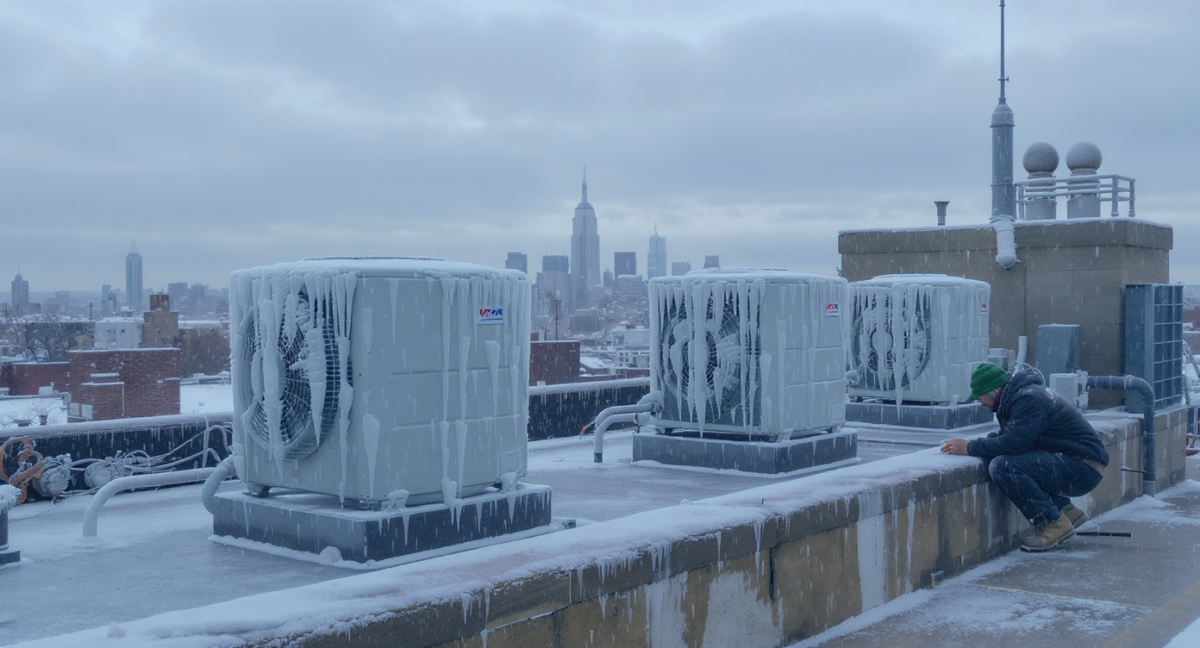
When the temperature drops below freezing and the calls start coming in from tenants about cold apartments or offices, you don’t have time to scroll through manuals. A VRF system that won’t heat in mid-January is a building emergency. And in NYC, where most commercial VRF installs are now 8 to 14 years old, VRF not heating calls are showing up more often than they used to.
Here’s a practical breakdown of what to check, what your staff can rule out before a service call, and where the problem stops being a DIY fix.
Start with the basics before assuming the worst
Before anyone touches a refrigerant gauge, confirm the system is actually being asked to heat. We’ve shown up to plenty of VRF not heating calls only to find a BMS schedule still set to cooling, a controller stuck in fan-only, or a setpoint that drifted during a power blip. Pull up the central controller and verify mode, setpoint, and active demand on each zone.
If the system is in heat mode and indoor units are running but blowing room-temperature air, that’s a different problem. That points to the refrigerant cycle, not the controls.
Also check whether it’s a single zone or a whole-system failure. One indoor unit blowing cold while the rest of the building heats normally tells you something very different than every floor going cold at once.
Reversing valve and four-way valve issues
VRF systems heat by reversing refrigerant flow. The four-way reversing valve at the outdoor unit determines whether refrigerant moves to the indoor coils as hot vapor or as a cold liquid. If that valve sticks, gets stuck mid-shift, or fails entirely, the system loses its ability to switch modes.
Symptoms: outdoor unit running, compressor running, indoor fans running, but no heat. Sometimes you’ll hear an audible click followed by a hiss when the valve tries to shift and fails.
This is one of the more common failures we see on aging Daikin VRV and Mitsubishi City Multi systems past the 8-year mark. The solenoid coil can fail electrically, the valve body can carbonize internally, or the shift mechanism can wear out. It is not something to diagnose with a multimeter from a folding chair. A licensed VRF tech needs to confirm.
Defrost cycle problems
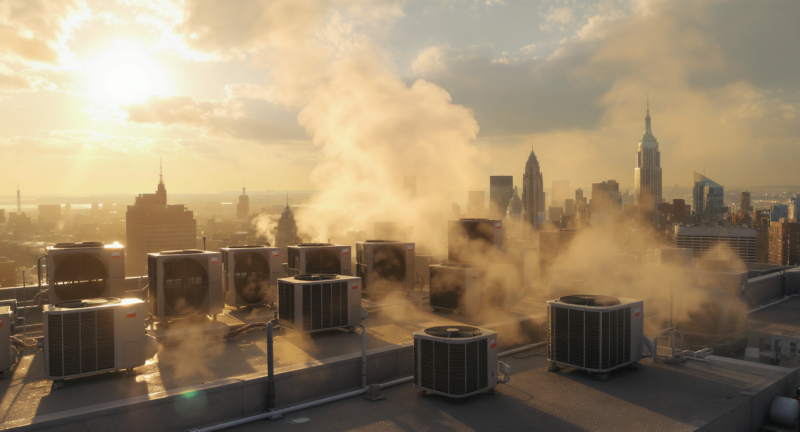
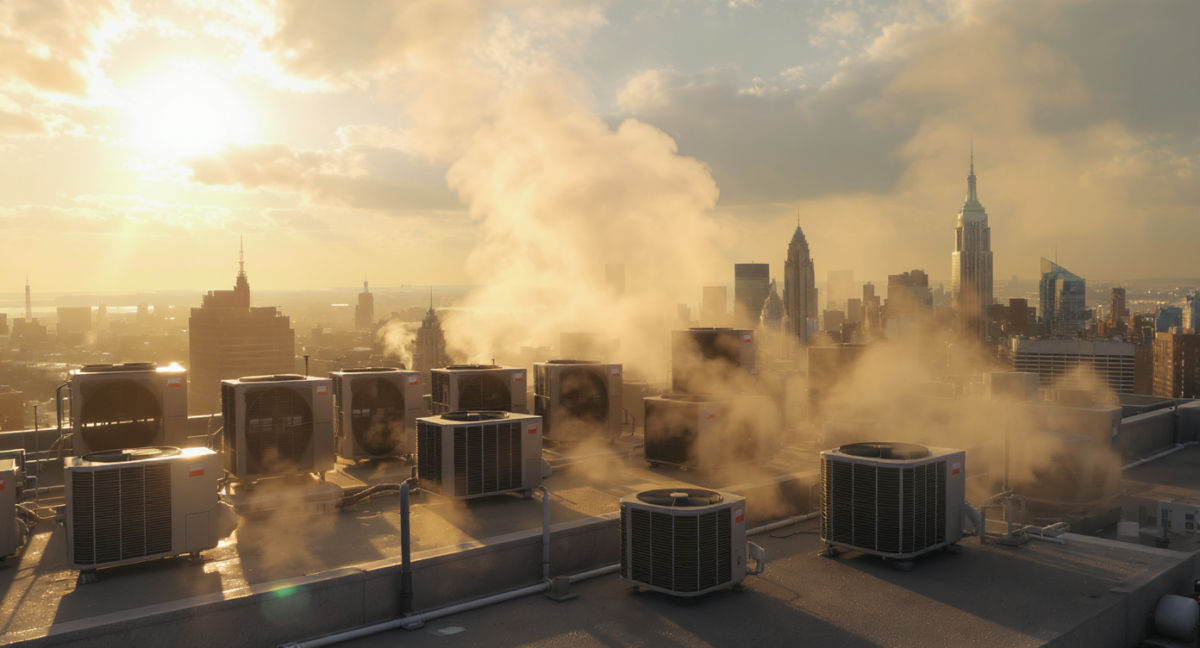
In NYC winters, VRF outdoor units ice up. That’s normal. The system runs a defrost cycle on a timer or based on coil temperature sensors, briefly switching to cooling mode to melt the frost. If you’ve ever seen steam rising off the condenser on a 25-degree day, that’s defrost doing its job.
When defrost fails, the coil ices over completely. Airflow drops to nothing, head pressure spikes, and the system locks out. Common defrost-related failures include:
- A failed coil temperature sensor reading wrong values
- A defrost timer board stuck or failed
- Snow or ice physically blocking the coil that mechanical defrost can’t clear
- Plugged condensate from melted frost refreezing in the drain pan
If you can see the outdoor unit from a roof access, a quick visual inspection answers a lot. Heavy ice on the coil with the unit running and no defrost cycling tells you the system isn’t recognizing the frost condition. If snow drifted over the unit after the last storm, that’s an access issue, not a mechanical failure.
Low refrigerant charge
VRF systems are unusually sensitive to refrigerant charge. Unlike a traditional split, where you can be a pound or two off and still get acceptable performance, VRF can lose meaningful heating capacity from a leak that wouldn’t even register on a residential system. And in long high-rise piping runs, slow leaks are more common than most building owners realize.
Symptoms of low charge during heating: short cycling, weak heat from the indoor units, coils that never reach full temperature, outdoor unit running constantly trying to reach setpoint. Sometimes a low-pressure alarm or refrigerant fault code, but not always early in the leak.
Refrigerant work requires EPA Section 608 certification and is not a building-staff item. If you suspect a leak, the system needs to be isolated, leak-tested, repaired, and properly recharged. Buildings that just keep topping off the charge without finding the leak end up paying for the same loss every year while the underlying problem grows.
Control board and inverter failures
Indoor and outdoor units in a VRF system each have their own control boards, plus inverter PCBs that modulate compressor speed. A VRF not heating call sometimes traces back to a failed sensor, a board that lost communication with the central controller, or an inverter that won’t ramp up properly.
Error codes are the fastest way to narrow this down. If the central controller is throwing P-series, F-series, or E-series codes, write them down before resetting anything. Each brand has its own code structure, and we cover Daikin VRV, Mitsubishi City Multi, LG Multi V, and Fujitsu Airstage codes in separate guides elsewhere on the site.
Don’t keep cycling power to clear codes. A persistent fault that recurs after reset is telling you something specific. Resetting it five times in a row makes the diagnostic story harder when a tech arrives, not easier.
When it’s time to call
If your VRF system has been running fine for years and suddenly won’t heat, the first 30 minutes of troubleshooting can usually rule out the simple stuff. Controls, mode, scheduling, visible ice, audible operation. Past that, you’re looking at refrigerant, valves, sensors, or boards, and those need a tech with VRF-specific training.
Mountain Mechanical has been working on these systems across Manhattan, Brooklyn, and Long Island since they were first installed. If you’re seeing a heating issue you can’t explain on a building you manage, call us at 833-504-HVAC.