VRF vs. Traditional HVAC: Which Is Right for Your NYC Building?
April 24, 2026
Mitsubishi City Multi Troubleshooting: The Most Common Issues We See
May 1, 2026
By the time a property manager calls us about a VRF system that has been “limping along,” there’s usually a binder of work orders going back two or three years. A compressor swap in 2024. A board replacement last winter. Three refrigerant top-offs since spring. The repair bills are real, the comfort complaints are louder, and the question is no longer whether to fix the thing. It’s whether the next fix is the one that finally tips the math toward replacement.
This is the harder side of VRF ownership, and it’s where the VRF repair vs replacement conversation actually happens. Not in a clean spreadsheet. In the moment a tech walks out of a mechanical room and tells you the second compressor on the same condenser is gone.
The 60 Percent Rule, and Why It Matters More for VRF
The traditional HVAC heuristic is simple. If a single repair cost runs more than 50 to 60 percent of replacement cost, replace the system. With conventional rooftop units or split systems, that’s a clean call. With VRF, the math is different in a way that catches a lot of building owners off guard.
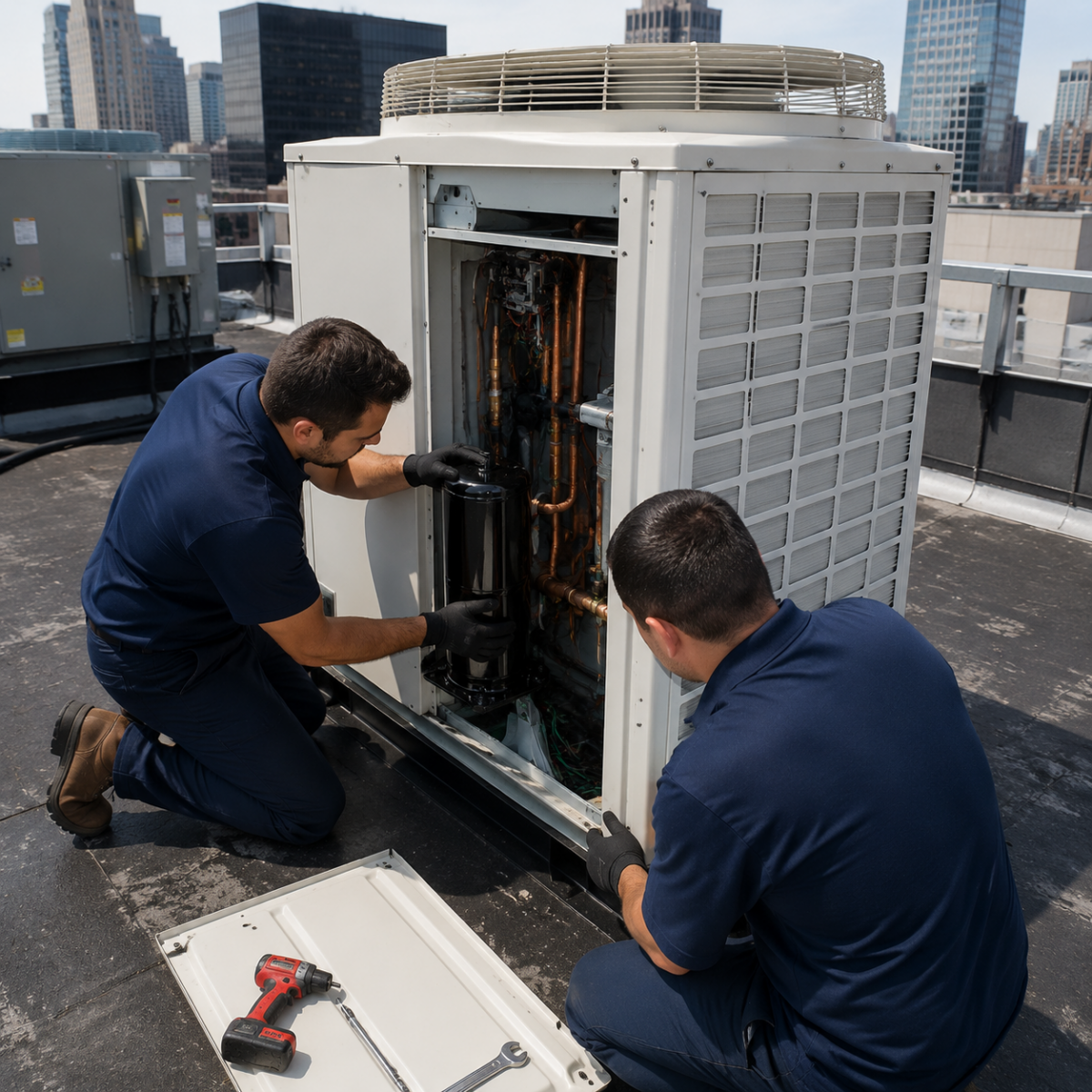
A VRF system is a network. One outdoor unit, branch selectors, refrigerant piping that may run hundreds of feet vertically, and dozens of indoor heads tied together by a controls bus. When a single compressor fails, you’re not replacing a discrete machine. You’re opening up a system whose other components are the same age, made by the same factory, exposed to the same Manhattan conditions for the same number of years.
So the 60 percent rule still applies, but the smart version of it asks a second question. Not just “what does this repair cost,” but “what is the probability the next repair lands within 18 months.” On a 10-year-old VRV or City Multi system, that probability is high. On a 6-year-old Multi V, it’s much lower. Age changes the meaning of the number.
What VRF Repairs Actually Cost in NYC
Realistic numbers help. These are the ranges we see on commercial work in Manhattan and the outer boroughs, depending on building access, crane requirements, brand, and tonnage.
- Compressor replacement, single unit: roughly 12,000 to 35,000 dollars installed, before any rigging premium
- Inverter board or main control board: 3,500 to 9,000 dollars depending on brand and parts availability
- Branch selector box replacement: 4,000 to 12,000 dollars per box
- Major refrigerant leak repair with full system charge: 8,000 to 25,000 dollars, more if piping has to be re-brazed in finished spaces
- Crane day for rooftop access on a high-rise: 4,000 to 15,000 dollars before any equipment cost
Now compare that to a full VRF system replacement on a typical 30 to 80 ton commercial install in Manhattan. Realistic ranges run 180,000 to 600,000 dollars and up, heavily dependent on whether the existing piping can be reused, building access, tenant disruption windows, and whether you’re upgrading controls and BMS integration at the same time.
That spread is exactly why the repair-versus-replace question rarely has a clean answer based on one invoice. It needs context.
An Age-Based Decision Framework
Here’s the framework we walk building managers through when the conversation gets serious. It’s not the only way to think about it, but it has held up across hundreds of Manhattan systems we’ve serviced.
Years 0 through 7
Repair. Almost always. The system is still inside its design life, parts are available, and most failures at this stage are isolated. Compressor failures here are typically warranty-adjacent or installation-related, not end-of-life signals. Fix it and move on.
Years 7 through 10
Repair, but start the capital conversation. The 2012 to 2017 install wave is sitting squarely in this window right now. One major repair is normal. Two majors in 18 months is the early warning. Begin a system assessment, document the current condition, and start budget planning so a replacement isn’t a fire drill in 2028.
Years 10 through 14
Repair only with eyes open. This is the failure window for compressors, inverter boards, refrigerant joints, and rooftop condenser corrosion. Single repairs over 30 percent of replacement cost should trigger a serious replacement analysis. Two majors in a 12 month window almost always means the next one is coming.
Year 14 and beyond
Replace. The economics rarely justify continued investment. Parts availability for older boards starts to thin out. Refrigerant transitions add complexity. And every dollar spent patching gets you a system that’s still 14 years old afterward.
The framework cuts across brand. Daikin VRV, Mitsubishi City Multi, LG Multi V, Fujitsu AIRSTAGE, Samsung DVM. The specifics differ. The arc doesn’t.
The Costs That Don’t Show Up on the Invoice
Repair invoices undercount the real cost of running an aging VRF system. A few that come up in every honest conversation with a property manager:
Tenant complaints. Every uneven cooling call, every overnight outage, every reschedule of a service visit because access wasn’t coordinated. These erode tenant satisfaction in ways that don’t fit on a pro forma but show up at lease renewal time.
Energy creep. A VRF system with degraded compressors, fouled coils, and worn-out controls quietly burns 15 to 30 percent more energy than a healthy one. On a Class A office in Midtown, that’s six figures a year before anyone notices.
Compliance pressure. Local Law 97 thresholds tighten in 2030. Buildings carrying inefficient mechanical equipment into that window are going to pay penalties or pay for upgrades. Patching a 12-year-old VRV through 2029 isn’t just a maintenance call. It’s a compliance decision.
Refrigerant economics. R-410A is being phased down. Pricing has climbed and supply has tightened. A leaky 2014-vintage VRF system isn’t just expensive to top off. It’s expensive to top off with a refrigerant that won’t be on the shelf forever.
How to Make the Call
The honest answer is that no single rule decides this for you. But three questions usually clarify it fast.
First, what does the next 24 months of repairs realistically look like, given the system’s current condition and age. A serious assessment from a contractor who has been in the equipment, not just looking at error history, gets you that answer.
Second, what’s the energy and compliance trajectory. If the building is heading into LL97 exposure with this system in place, the calculus shifts even if the next repair looks affordable.
Third, what’s the disruption window for replacement. VRF replacement on an occupied Manhattan building isn’t a weekend job. The right time to start planning is two years before the system forces your hand, not the week the second compressor fails.
Mountain Mechanical has been servicing VRF systems across Manhattan since they were first installed. If you’re sitting on a system that’s hitting the 10-year mark and you’re not sure whether the next call is repair or replacement, that’s a conversation worth having before the system makes the decision for you.