When VRF Heat Recovery Actually Pays Back Faster Than Standard Heat Pump VRF
April 20, 2026
Signs Your VRF System Needs More Than a Band-Aid Fix
April 28, 2026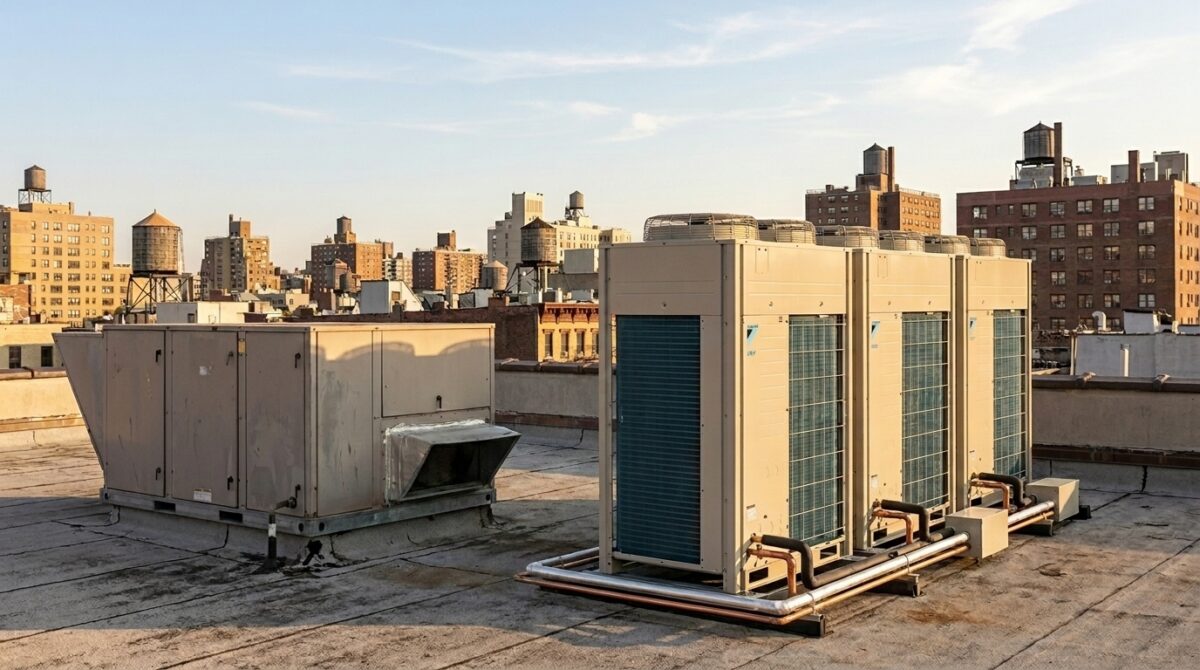
Most NYC property managers evaluating a major HVAC replacement end up in the same room with the same question: do we stay with what we have, or do we go to VRF. The honest answer depends on the building, the load profile, and how long you plan to own the asset. VRF is not automatically the right call, and the contractors selling you otherwise are usually selling VRF.
What follows is a straight comparison for commercial buildings in Manhattan, the outer boroughs, and the surrounding metro. No marketing angle. Where VRF wins, where traditional systems still win, and what the real cost math looks like in this market. If you are weighing the same question for a home rather than a commercial property, that is a different discipline, better handled by a residential HVAC contractor on Long Island.
What each system actually is
Traditional commercial HVAC in NYC usually means one of three setups. A central plant with chillers and boilers feeding air handlers and fan coils. Rooftop packaged units serving zones through ductwork. Or water source heat pumps tied to a condenser loop. Each has been the default in various building types for decades and each has a mature service ecosystem behind it.
VRF, variable refrigerant flow, moves refrigerant directly from an outdoor condenser to multiple indoor units through a shared piping network. A single outdoor system can serve dozens of indoor fan coils, each with its own setpoint. Heat recovery VRF can heat one zone while cooling another simultaneously, which is where the efficiency story gets interesting in mixed-use and mixed-orientation buildings.
Where VRF makes clear sense
VRF earns its cost premium in buildings with highly variable loads, tight mechanical space, or strong zone control requirements. A few common cases where the math usually works in NYC:
- Luxury residential conversions and condos where individual suite control is a sale feature and tenants will complain about anything less
- Mid-rise office buildings with mixed sun exposure, so the north and south sides are fighting each other eight months of the year
- Hotels and hospitality where PTAC replacement is on the table and noise, aesthetics, and guest comfort all matter
- Buildings with no real place to hide rooftop packaged equipment and limited shaft space for ductwork
- Gut renovations where the existing distribution is being torn out anyway and the incremental cost of going VRF is smaller than it looks on paper
- Buildings chasing Local Law 97 compliance where fossil fuel boilers are a liability and full electrification is on the five to ten year horizon
The zone control piece matters more than most brochures make it sound. In a 200,000 square foot office floor plate, VRF lets tenants run their space however they want without affecting the guy down the hall. Central systems with VAV boxes can do this too, but the comfort delivery tends to be less precise and the controls are harder to keep commissioned over time.
Where traditional systems still win
There are building types and ownership profiles where VRF is the wrong answer, and honest contractors will tell you so.
Large single-use buildings with steady, predictable loads often run more economically on central plants. A 500,000 square foot Class A office tower with a stable tenant mix does not need the granularity VRF offers, and the central plant economy of scale is real. Industrial and heavy process facilities generally need equipment VRF is not built for.
Buildings with very low expected hold times are another case. VRF systems carry a higher first cost and the payback math assumes you are operating the system for ten to fifteen years. If the building is going through a trade sale in three years, the buyer will not pay you back for the VRF premium. Stick with what works and what the next owner can service without hunting for factory-trained techs.
Parts availability is the other piece owners underestimate. A twenty year old rooftop unit can almost always be fixed. A twelve year old VRF system running on a discontinued board with no replacement path can turn into a capital event very quickly. We are seeing that play out across Manhattan right now with VRF systems installed between 2012 and 2016 hitting the age where boards, compressors, and EEV assemblies start failing and factory parts get harder to source.
NYC cost ranges you can actually plan around
Numbers vary with building type, access, and scope, but for commercial installations in the five boroughs, these ranges hold up reasonably well at the planning stage.
- Rooftop packaged unit replacement, 10 to 20 tons: roughly $35,000 to $75,000 per unit installed, depending on crane access and controls integration
- Water source heat pump replacement, per zone: $6,000 to $12,000 per unit including ductwork tie-in
- New VRF system in a mid-rise retrofit, heat pump VRF, per ton: $8,000 to $14,000 installed, varies heavily with piping runs and indoor unit count
- Heat recovery VRF adds roughly 15 to 25 percent over standard heat pump VRF, sometimes more on complex layouts
- Central chiller plant replacement, water-cooled: $2,500 to $4,000 per ton of cooling, plus tower and pump scope
Rigging, crane, and permit costs are the biggest wildcards in this market. A rooftop VRF condenser swap on a 28 story Midtown building can add $40,000 to $80,000 in crane and street closure costs before any equipment hits the roof. Factor that in early, not at change order time.
How to decide
A few questions that will usually tell you which direction to lean without needing a full engineering study:
- How variable are the loads across zones and hours of the day. The more variable, the stronger the VRF case.
- How long do you plan to own and operate the building. Under five years, lean traditional. Ten plus, the VRF math starts paying back.
- What does your mechanical space look like today. If you are space-constrained, VRF is often the only viable path.
- Is Local Law 97 compliance driving the decision. If so, electrified systems, including VRF, move up the list.
- Can the existing distribution be salvaged. If yes, replacing in kind is often the lower risk move. If no, you have more flexibility to rethink the whole system.
The short version
VRF is a powerful tool in the right building. It is also oversold, and we see enough poorly applied VRF installations in NYC to know that a bad VRF design is worse than a well executed traditional system. Before you commit, get a load profile, an honest first-cost comparison, and a twenty year operating cost projection. The answer will usually be clear once the numbers are on paper.
Mountain Mechanical has worked on both sides of this comparison across the NYC market for more than 35 years, and most of our VRF work now is second-owner service on systems that were installed poorly the first time. If you are weighing a replacement decision and want a straight read on your options, reach out and we will walk through it with you.