


VRF Maintenance Best Practices for NYC Building Managers
April 3, 2026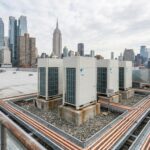
Why VRF Systems Are Failing Across Manhattan Right Now
April 8, 2026
VRF systems are commercial heat pumps. The same equipment that specifying engineers call “Variable Refrigerant Flow” is what building owners, utilities, and regulators call commercial heat pumps. Both terms describe the same electrified refrigerant-based HVAC technology discussed below.
Walk through the mechanical rooms of Manhattan’s commercial buildings and you will find a story in transition. Aging gas-fired boilers and central air handlers that served their buildings for 30 years are being evaluated for replacement not just on age, but on regulatory necessity. The question building owners and engineers are increasingly asking is not whether to upgrade, but what to upgrade to — and VRF is winning that conversation at a rate that would have seemed unlikely a decade ago.
This shift is being driven by a convergence of factors: the tightening emissions requirements of Local Law 97, the advancement of VRF technology to handle even the most demanding commercial applications, and a growing body of real-world evidence from buildings that have already made the transition. Understanding why Manhattan buildings are choosing VRF over central air starts with understanding what central air systems cannot do that VRF can.
The Limitations of Central Air in Dense Urban Buildings
Central air systems (whether chilled water, DX rooftop, or fan coil with centralized plant — were designed for buildings with relatively uniform load profiles and simple zoning requirements. They work reasonably well when every floor has similar occupancy patterns and the same heating and cooling needs at the same time.
Manhattan commercial buildings rarely fit that description. A mixed-use property with ground-floor retail, office floors in the middle, and residential or hotel space above has wildly different thermal loads across zones at any given hour. A central system serving this kind of building either overcools some zones to satisfy others, requires expensive zone-by-zone VAV systems to compensate, or simply fails to maintain comfort across the building without constant manual intervention.
VRF handles this inherently. Each indoor unit operates independently within the refrigerant network, modulating its output continuously based on the actual load in its zone. A north-facing conference room that needs heating and a south-facing office that needs cooling at the same time — a scenario that causes central systems to compromise — is simply normal operation for a heat recovery VRF configuration.
Energy Efficiency That Shows Up on the Utility Bill
The efficiency advantage of VRF over central air is well-documented, but the magnitude surprises most building owners who have not yet made the comparison. A modern VRF system operating in New York City’s climate will typically deliver a seasonal coefficient of performance (COP) of 3.5 to 4.5 in cooling mode — meaning it delivers 3.5 to 4.5 units of cooling for every unit of electricity consumed.
A conventional central air system operating at the same scale will deliver a seasonal COP of 2.5 to 3.0 at best, and older systems running on degraded equipment perform considerably worse. The difference in energy consumption on a like-for-like basis is 20 to 40 percent, depending on building type and system age.
For a mid-size Manhattan commercial building spending $200,000 annually on HVAC energy costs, a 30 percent efficiency improvement represents $60,000 in annual savings. That is a material return on the capital investment required for VRF installation NYC — and it compounds over the system’s life.
Local Law 97 Is Accelerating the Shift
If efficiency and comfort were the only factors, the transition to VRF would be happening more gradually. Local Law 97 is compressing the timeline significantly.
Buildings that rely on gas-fired heating systems face a structural compliance challenge under LL97. The law’s emissions limits are calibrated to reward electrification — buildings that eliminate combustion from their HVAC systems earn an immediate and substantial reduction in their calculated emissions footprint. For buildings currently running gas boilers alongside DX cooling, conversion to VRF often eliminates the gas consumption entirely, replacing it with high-efficiency electric heat pump operation.
The math is compelling: a building facing $150,000 in annual LL97 penalties for exceeding its emissions limit can often eliminate or dramatically reduce that liability through a VRF conversion that pays for itself in avoided penalties within three to five years. That calculation is prompting building owners who might otherwise have deferred capital investment to accelerate their HVAC planning cycles.
Space Savings in Buildings Where Space Is Money
In Manhattan, mechanical space is not free. Central air systems require dedicated equipment rooms, large-diameter ductwork running through ceiling plenums, and cooling tower or condenser water infrastructure that consumes rooftop or basement space. In many existing buildings, the mechanical space consumed by legacy central air systems represents rentable square footage that the building cannot recover.
VRF systems replace most of that infrastructure with compact outdoor units — typically mounted on rooftops or building facades — and small-diameter refrigerant piping that routes through much tighter pathways than ductwork. Indoor units are ceiling-cassette, duct-connected, or wall-mounted configurations that fit within standard ceiling cavities. For building owners undertaking gut renovations or repositioning older properties for new tenants, the mechanical space recapture alone can justify the VRF installation cost.
Noise, Tenant Experience, and Modern Building Standards
Building tenants — particularly in Class A office and high-end residential — notice HVAC noise in a way that affects lease decisions. Central air systems, especially aging ones operating with worn fan bearings and unbalanced ductwork, generate a level of background mechanical noise that modern tenants increasingly find unacceptable.
VRF indoor units operate at 20 to 30 decibels in most installations — quieter than a typical conversation. The variable-speed operation means there is no loud startup or shutdown cycle. For buildings competing for quality tenants in a market where the physical environment matters, quiet HVAC is not a luxury — it is a baseline expectation.
Which Building Types Are Making the Switch
The adoption of VRF over central air in Manhattan is not limited to any single building category. The buildings leading the transition include:
- Class B and C office buildings undergoing capital improvements to compete with newer stock and attract quality tenants
- Mixed-use developments where the zoning flexibility of VRF solves the central system’s inability to serve diverse occupancy types efficiently
- Boutique hotels and high-end residential buildings where quiet operation and individual room control are non-negotiable
- Institutional buildings — schools, medical offices, community facilities — where LL97 compliance and operational cost control are both priorities
- Historic properties where limited ceiling height and restricted riser space make ductwork-based systems impractical
What to Consider Before Switching
VRF is not a universal solution, and the decision to convert from central air deserves careful analysis. Key considerations include:
Building envelope and load calculation. VRF systems are sized to match calculated heating and cooling loads. Buildings with poor insulation, significant air leakage, or unusual occupancy patterns may require envelope improvements alongside VRF installation to achieve expected performance.
Refrigerant piping routes. VRF refrigerant lines must run from outdoor units to every indoor unit in the building. In occupied buildings, planning these routes without unacceptable disruption to tenants requires experienced design and project management.
Outdoor unit placement. VRF outdoor units require adequate clearance for airflow and access. Rooftop placement is most common in Manhattan, but structural loading, local zoning requirements, and noise ordinances all factor into the planning.
Selecting the right contractor. VRF installation is not a commodity service. The system design, refrigerant piping quality, commissioning, and ongoing support all depend on working with a contractor who has genuine VRF expertise. A poorly commissioned VRF system will underperform regardless of equipment quality.
Mountain Mechanical NY has been designing, installing, and servicing VRF systems for commercial buildings across New York City. If you are evaluating VRF for your building — whether driven by LL97 compliance, equipment age, or a planned renovation — we can provide an honest assessment of what the transition would involve and what it would deliver.
Learn more about VRF for your building: VRF Systems Overview | VRF vs. Traditional HVAC | Call 833-504-4822 | Contact Mountain Mechanical