Mitsubishi City Multi Error Codes: A Building Engineer’s Reference Guide
April 10, 2026
Fujitsu Airstage Error Codes: A Field Reference for NYC Building Engineers
April 14, 2026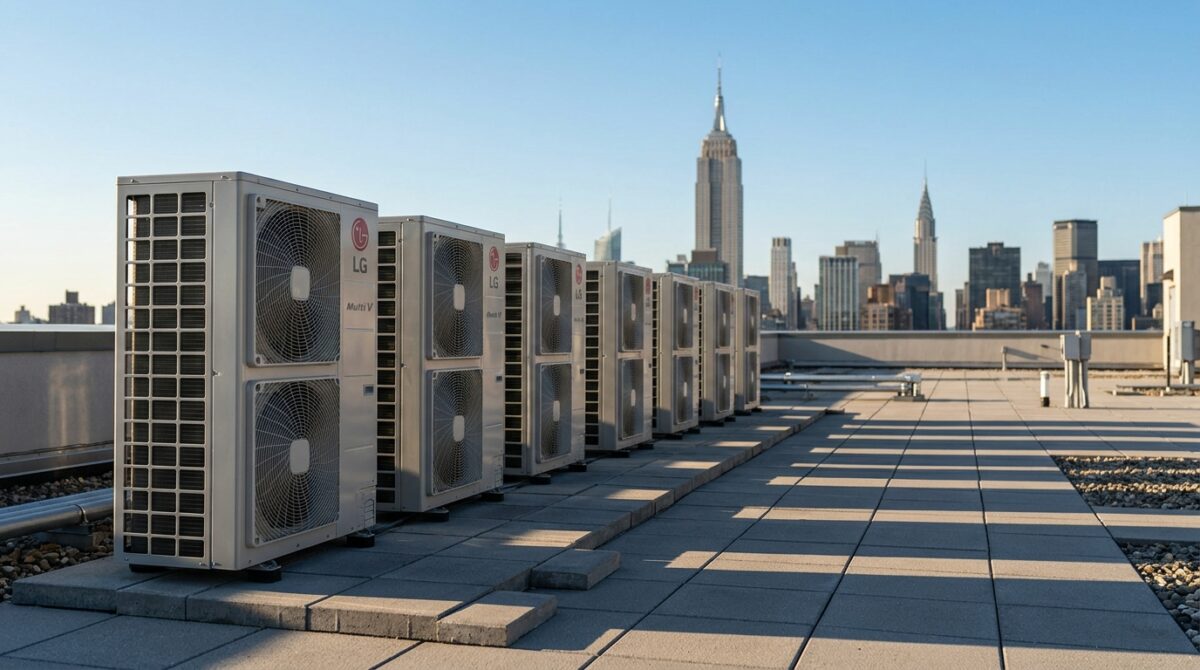
Understanding LG Multi V Error Codes
LG Multi V systems have earned a strong foothold in New York City’s commercial buildings over the past decade. Their compact outdoor units and flexible piping configurations make them a practical choice for mid-rise office buildings, mixed-use developments, and condo conversions where mechanical room space is limited. But like any complex HVAC system, Multi V units communicate problems through error codes that building engineers need to understand quickly, especially when tenants are on the phone.
This guide covers the most common LG Multi V error codes you’ll encounter in the field, what they actually mean, and what steps to take before calling in a service contractor.
How LG Multi V Error Codes Work
LG uses a two-digit alphanumeric coding system displayed on the outdoor unit’s PCB and on the wired remote controller at each indoor unit. Codes beginning with “CH” indicate sensor-related faults. Codes starting with numbers (like 21, 22, 51, 53) point to compressor, inverter, or communication failures. The indoor unit controller will also flash specific LED patterns depending on the fault type.
One thing worth noting: LG’s error code structure differs between the Multi V II, III, IV, and 5 platforms. A CH05 on a Multi V III may have a slightly different root cause than the same code on a Multi V 5. Always cross-reference the specific generation’s service manual when diagnosing.
Common Sensor and Temperature Fault Codes
Sensor faults are the most frequent errors building engineers encounter on LG Multi V systems, and many are straightforward to diagnose.
CH01 indicates an indoor return air thermistor fault. This is the sensor that reads room temperature at the return grille of the indoor unit. A dirty filter restricting airflow across the sensor, a disconnected thermistor wire, or a failed sensor are the most common causes. Check the connector at the PCB first before replacing the sensor itself.
CH02 is an indoor pipe (coil) temperature sensor error. This thermistor sits on the evaporator coil and monitors refrigerant-side temperature. If the reading drifts outside the expected range, the unit flags CH02. Corroded connections at the sensor lead are a common culprit in older NYC installations, particularly in buildings near the waterfront where humidity accelerates corrosion.
CH05 signals an outdoor unit pipe temperature sensor failure. This one monitors discharge or liquid line temperature at the outdoor heat exchanger. On rooftop installations across Manhattan and Brooklyn, years of UV exposure and thermal cycling can degrade the sensor wiring. Inspect the sensor leads and weatherproofing before assuming the sensor itself has failed.
CH07 is an outdoor ambient temperature sensor fault. Since the system relies on this reading for capacity modulation and defrost logic, a failed CH07 sensor can cause the entire system to lock out. Rooftop units in the NYC metro area take a beating from wind, ice, and salt air. Checking the sensor housing for physical damage is always the first step.
Compressor and Inverter Error Codes
These codes are more serious and typically require a qualified VRF technician to resolve. Understanding what they mean, though, helps building staff communicate the problem accurately and avoid unnecessary emergency service calls.
Code 21 indicates a compressor overcurrent condition. The inverter board has detected current draw exceeding safe limits. Possible causes include a restricted liquid line, overcharged system, failed EEV (electronic expansion valve), or a compressor approaching end of life. On systems installed in the 2013-2016 wave of VRF adoption across NYC, compressor wear is an increasingly common root cause as these units cross the 10-year mark.
Code 22 is an inverter overcurrent fault, meaning the drive board itself is reporting excessive current rather than the compressor motor. This can indicate a failing inverter board, a short in the compressor winding, or power quality issues at the building’s electrical service. In older Manhattan commercial buildings with aging electrical infrastructure, voltage sags and harmonics from other loads can trigger this code intermittently.
Code 32 points to high discharge temperature. The compressor discharge line is reading above the safe threshold, which typically means the system is low on refrigerant, has a restriction in the liquid line, or is operating with a failed outdoor fan motor reducing heat rejection. On rooftop units in the summer, this code often appears during the first extended heat wave of the season when the system is pushed to full capacity for the first time in months.
Code 40 is a CT (current transformer) sensor error on the outdoor unit. The CT sensor monitors compressor current for protection purposes. A failed CT or loose connector will trigger this fault and prevent the compressor from running.
Communication Error Codes
Communication faults between indoor and outdoor units are among the trickiest to diagnose on any VRF platform, and LG Multi V is no exception.
Code 51 means the outdoor unit has lost communication with one or more indoor units. Check the two-wire communication bus for damaged insulation, loose terminal connections, or improper polarity. In buildings where the communication wiring runs through elevator shafts or alongside high-voltage conduit, electromagnetic interference can cause intermittent 51 faults that are difficult to replicate.
Code 53 indicates communication failure between the master and slave outdoor units in a multi-unit configuration. This is common in larger NYC installations where two or three outdoor units are connected to serve a single refrigerant system. Verify that the inter-unit communication cable is intact and that the DIP switch settings correctly designate which unit is master.
Code 61 is a communication error specific to the wired remote controller. A bad connection at the controller terminals, a damaged communication cable between the controller and indoor unit PCB, or a failed controller board can all trigger this fault.
What to Do Before Calling for Service
Building engineers can resolve a meaningful percentage of LG Multi V faults without a service call. Start with the basics: verify that the error code matches what the controller is displaying versus what the outdoor unit PCB shows. Power-cycle the affected indoor unit by switching off its breaker for 60 seconds, then restoring power. Check for dirty filters, blocked return air grilles, or any obvious wiring issues at accessible terminal blocks.
For communication faults (51, 53, 61), check that no recent electrical work in the building has disturbed the communication wiring. Contractors pulling new circuits through shared conduit runs have been known to nick or disconnect VRF communication lines without realizing it.
Document the error code, the time it occurred, the outdoor temperature, and which zones were calling for heating or cooling. This information saves your service contractor significant diagnostic time and keeps your repair costs down.
When the System Needs Professional Attention
Compressor and inverter codes (21, 22, 32, 40) almost always require a certified VRF technician with proper recovery equipment and manufacturer-specific diagnostic software. The same goes for recurring communication faults that persist after basic troubleshooting.
If your building is running LG Multi V equipment installed during the 2012-2016 period, proactive maintenance is more important now than ever. These systems are entering the phase of their lifecycle where compressor failures, refrigerant leaks at flare joints, and inverter board replacements become more frequent. A scheduled service agreement that includes annual refrigerant charge verification and electrical testing can catch problems before they become tenant complaints.
Need to look up a Multi V code that isn’t covered above? Our free VRF error code lookup covers 450+ codes across LG Multi V and the other four major brands, with severity and next-step guidance for each.
Mountain Mechanical specializes in LG Multi V service, maintenance, and system replacement for commercial buildings across New York City. If your building team is dealing with recurring error codes or aging VRF equipment, our engineers can assess the system and recommend the right path forward.